Saturday, 28 January 2012

GROUP A2 : DAY 10 @ DHO KUBANG PASU

Date : 19 January 2012 (Thursday)
Time: 8.30 – 11.00 am

        
         We were scheduled for another day of disease control session.Upon arrival, we were being fed with information regarding TB, HIV/AIDS as well as Aedes larvae species identification in the laboratory.

A. Tuberculosis
        PKD Zadi updated us with informations regarding TB department.

Objectives:
1. Notification
        - This can be done via online notification or the hard copy form entry (10A-1) by doctors to PKD  
        - Normally done after positive lab results of sputum positive

2. Registration
        -PKD then will investigate and register accordingly into either:
                     1. Pulmonary +ve ( Infectious )
                     2. Pulmonary –ve ( Non infectious: sputum –ve but X-ray +ve )
                     3.Extrapulmonary (Non infectious: Presence of bacteria but couldn’t be excreted by coughing )

3.Treatment
        - Here, a 6 month treatment plan is followed:
                  2 month of intensive medication --> Sputum –ve --> Once 1 weekly          
          
There is two type of centres for treatment:
     Pusat Rawatan 1 whereby investigation such as X-ray and laboratory confirmation can be done and thus, starting a treatment plan. Only Hospital Jitra and KK Changlun are PR1 in this district.
     Pusat Rawatan 2 is where treatment plan can be started but only continued. More like following up for treatment plan arranged earlier.

4. Disease control
        - Contact tracing is a must after every notification as this will help to control the spread of TB to others.
        - We were being enlightened with the fact that UV light is able to kill the TB bacteria. Therefore, all windows In the house will be opened upon home visitations as most of the TB patients live in the dark.

Below are the TB case records for 2011:


        We were informed that there was an increase of 2 cases in 2011 (100 cases) compared to 2010 (98 cases) and most of the patients were elderly more than 60years old.
However, there isn’t any programs deliberate yet for TB control in this DHO.

B. HIV/AIDS/STI
          This session was taken by PKD Razali and we were shortly briefed about HIV and AIDS and their differences.

Obejectives:
1.  Notification
        - Similar to the TB department, notification can be done through e-notification and also an investigation form from the National AIDS Registry (NAR)
        - only after 2 positive results
        -mostly from hospital and also screening programs

2. Source identification
        - Upon notification, patient will then be contacted and a home visit will be done
        - This is when the source of HIV/AIDS can be identified

 3.Registration
         - After source identification, this will be followed by system input and registration by PKD to State Health Department Putrajaya
         - Registration can be categorized into either HIV,AIDS and death.

4. HIV Management programs
         - Anonymous Screening Program
                                -Screening test done without the need of giving names
                                -Pre-married couples, pregnant mothe
         -Needle Sharing Exchange Program
                - Only in KK Ayer Itam
                - A set of 8 needles were given to the drug user and new needles can be exchanged 
                  depending on the amount of needles returned by the same drug use
                - So far 2 persons were on this program in year 2010 only.
- HIV talks given by doctors
            -Counseling
            -Most of these programs are targeted to high risk groups like teens, homosexuals as well as drug abusers.

5. Corpse Management
          -DHO is responsible to train around 100 people to deal with this matte
          -Collaboration with AADK ( Religion office )
          - Trained personnel will be aware of the safety precautions taken before handling the corpse which includes equipment protections
          - Normally, washing of the body with sodium hypocloride (Dilution 1:10) will be the first and last procedure.        


*Data for year 2008 was still recorded as total cases and wasn’t recorded separatively


C. Aedes Larvae Identification
                We were divided into smaller groups and brought into the laboratory where mosquito larvae can be identified microscopically. The larvae will first be preserved in 70% ethanol and then be viewed under 10x megapixel microscope.  We were taught that the larvae can be divided into head, thorax, abdomen and siphon.The abdomen can be further divided into smaller divisions and to identify the different species, we were given the chance to look at the 8th division of the abdomen for the different types of spine under the microscope. Today's session was dismissed around 11am after all the information loading.


Reported by,
Loh Sue Anne


Tuesday, 24 January 2012

GROUP A1 - DAY 10 @ DHO KOTA STAR

Arrived at 7.50am.

Joined the meeting the Food Safety Unit had at 9.30am.

It was a pre-field work meeting for OP Raya (Festive Operation).

The aim was to compound those who smoke in public area (public areas in Malaysia are smoke-free zones).

Today we went to Mahkamah Sesyen dan Majistret Alor Setar (Alor Setar Sessions and Magistrate Court).

They issued fines to those who were caught smoking in the court area.

Process: 1) A health officer notices a person smoking in a public area.
              2) The health officer approaches him/her and immediately shows his/her badge.
              3) The cigarette bud in taken hold of in an instant and placed in a container to be
                  used as evidence in court if necessary.
              4) The health officer issues a fine to the offender and explains why he is being
                  fined, how and where he can pay the fine and by when he must pay the fine
                  and consequences of failing to pay the fine in a given time (usually 2 weeks).


The fine for adults who were caught smoking in public area was RM200 while those under-18 years old offenders were fined RM50. In addition to that, possession of tobacco by those who are under 18 years of age is also illegal. Offenders are given 2 months to pay the fine at the nearest DHO. Failing to do so will result in an order to appear before a judge in court.


Around 11am we left the Court and we to a bus stop.

The aim going there was to distribute ‘’NO-SMOKING” stickers to taxi drivers.


They also managed to fine a few people who were caught smoking around the bus stop area.

We departed towards SP at 12.15pm.

By, Sarwinder Singh.

Wednesday, 18 January 2012

GROUP A1- DAY 9 (DHO KOTA SETAR)

DATE : 18 JAN 2012
TIME : 8AM
DHO : KOTA SETAR
DEPARTMENT : FOOD SAFETY AND QUALITY CONTROL

Welcoming speech and briefing by En. Wan Qayim Bin Wan Izaham (Health Inspector for Food Safety and Quality Control)

There is 7 Health Inspector under this department and divided 2 person per team, 1 person as data collector

Areas involved for this unit operation are:
1. Kota Sarang Semut
2. Pokok Sena
3. Kubang Pasu (i -port, Kepala Batas)
4. Alor Tunggal (Simpang Kemboja)

Activities done:
1. Food sampling- sample collected and sent to the laboratory for analysis
a.) Chemical - color and food additives
- heavy metals

b.) Microbiology - bacteria (salmonella, e.coli)
- fungal

c.) Physical - foreign material ( organic or inorganic)

d.) Residual Drugs - beta agonist, chloramphenicol, Formaldehyde

e.) Biotechnology - DNA test of food

2. Laboratory analysis - process the food 
It takes about 1 week to process microbiology components and 1 month to process chemical components.

Laboratory available in Malaysia are :
Food safety and quality control lab in Bukit Kayu Hitam, in Kangar, in Penang, in Sungai Buluh, Petaling Jaya and Johor

3. Food premises inspection
Premises that is checked are :- hotels, restaurant, canteen, shops, hawker stalls, market(mini n hyper)
According to the law, if any premises is not clean and does not follow the rules, the unit have the rights to close down the premises

Law according to this 2 sections
Section 11- Food Act (Close the shop for 14 days)
Section 18- Act of Disease Control (duration depends on cleanliness of the premises either prone for disease)

4. Health certificate 
Only given in the port for Exporting food to overseas
Application of certificate is RM80 valid for 3 mnths

5. Grading of premises (certificate for clean premises) - according to score
Grade A - more than 76
Grade B - 61-75
Grade C - 50-50

Complain from public can be made through phone or written statement

After the briefing, we followed En Wan for food collection and sampling in Tesco Stargate Alor Setar..

That all for today.. Thank you

-KAVIRANI NADARAJAN MONEY-

Group A1 - Day 8 DHO Kota Star

It is our 8th day of posting at Kota Star District Health Office(DHO) on Tuesday, 17th January 2012.We were at the Klinik Kesihatan adjacent to the DHO, to gain insights on non-communicable disease epidemiology & health care.

We had a question-answer session with the medical assistant in-charge of the clinic.

We had oppurtunity to attend the diabetes clinic, to meet patients & healthcare workers who are involved in non-communicable disease management in the clinic.

We exposed to the diagnostic facilites availbale in the clinic....the Fundocamera was the highlight..:)


It was short day....

Group A2 : Day 9 @ DHO Kubang Pasu

                                          MCH- KLINIK DESA MALAU


It is our ninth day of posting in the Districh Health Office of Kubang Pasu on Wednesday, 18th January 2012. Upon our arrival at about 8.50 am, we were told to go to Klinik Desa Malau. Hence, we departed right after that, being accompanied by a staff nurse, Asma. It was a 10 minutes journey from DHO Kubang Pasu.

Klinik Desa Malau is a healthcare clinic which is under the supervision and management of Klinik Kesihatan Kubang Pasu, the headquarters of 4 other healthcare clinics as well, such as, Klinik Desa Telok Malik, Klinik Desa Binjal,. Klinik Desa Gelong and Klinik Desa Paya Pahlawan.


KLINIK DESA MALAU


Map showing areas covered by Klinik Desa Malau


There are only 2 community nurses available in the clinic, without any consultation from the medical officers or specialist. The services provided here are:

a) Ante natal care - Uncomplicated cases of pregnant mothers. Cases which fall under high risk category will be referred immediately to Klinik Kesihatan Kubang Pasu for further consultations.

b) Post natal care - Home visits are conducted by the community nurses on the 1st, 2nd, 3rd, 4th, 5th, 6th, 10th and 20th days, with the least number of visits done is 8, to check the mother and the baby.

c) Family planning - Community nurses offer counselling sessions besides providing the patients with methods of contraception. However, the methods are limited, as only contraceptive pills and condoms are available.

d) Child care - Immunization , growth chart plotting and nutrition counselling are done for newborn babies to children up to 7 years of age. This is to ensure optimum growth and development of child and for complete immunization before school entry. Frequency of visits for a child  :

  • Newborn - 6th month : Monthly
  • 7th month - 12th month : 2 monthly
  • 1 year - 2 years : 3 monthly
  • 2 years - 4 years : 6 monthly
  • 5 years - 6 years : Yearly


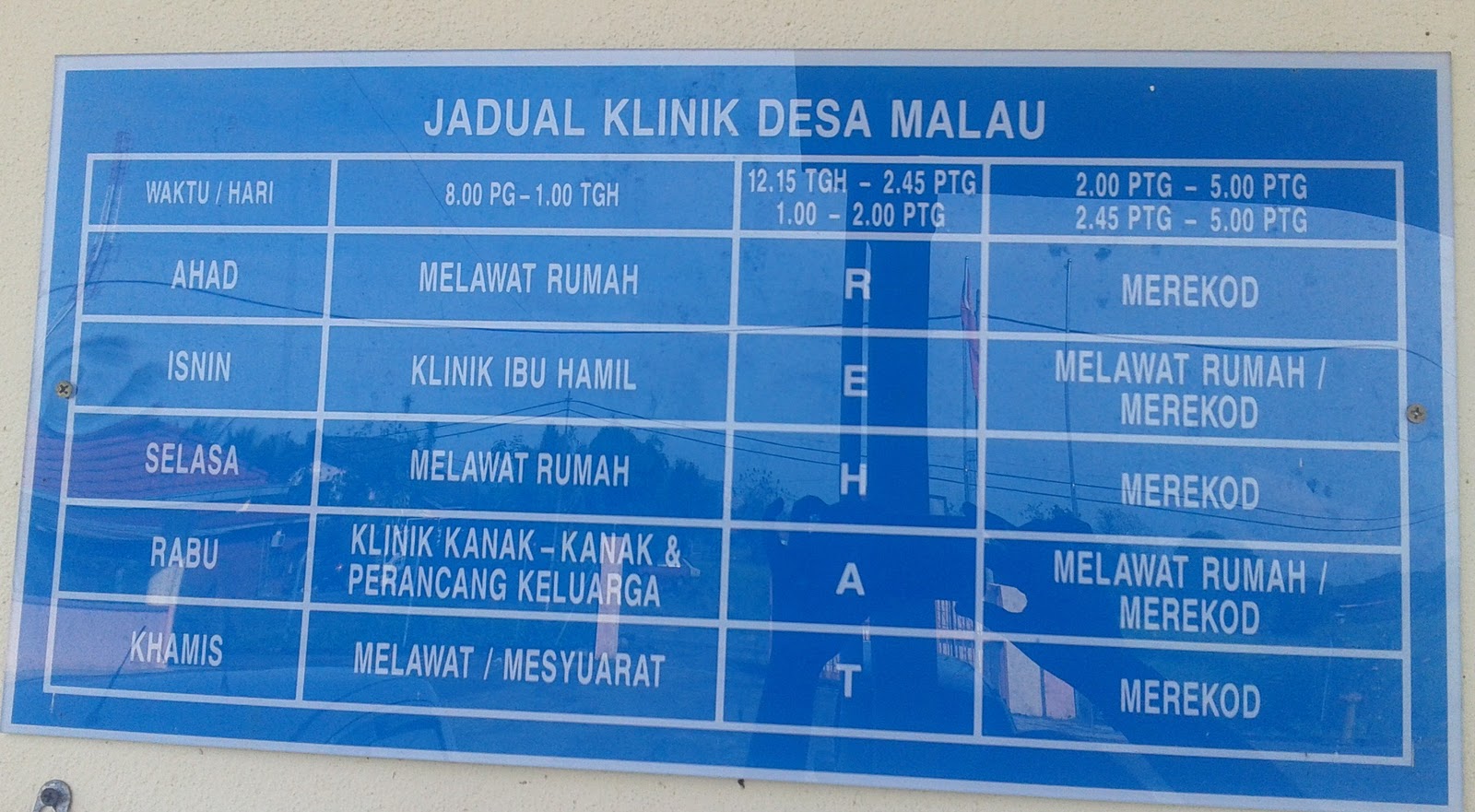
Daily schedule of Klinik Desa Malau

Daily activities carried out at Klinik Desa Malau is as mentioned below:
Sunday : Home visits / recording data
Monday : Ante natal clinic
Tuesday : Home visits / recording data
Wednesday : Child health and family planning clinic / home visits / recording data
Thursday : Home visits / meeting / recording data


This healthcare clinic offers the same services as those being offered in the Klinik Kesihatan Kubang Pasu. The only difference is that  Klinik Desa Malau manages the uncomplicated cases of pregnancy whereas all those high risk cases are being managed in Klinik Kesihatan Kubang Pasu. I have already elaborated about all the objectives and flow of processes of ante natal, post natal as well as child health care in the blog thread Group A2 : Day 2 @DHO Kubang Pasu on 5th January 2012. Kindly have a look at it. http://mbbs14a.blogspot.com/2012/01/group-a2-day-2-dho-kubang-pasu.html


Staff Nurse Asma explaining about the services offered in Klinik Desa Malau


Furthermore, we were told by SN Asma that, Klinik Kesihatan Malau organizes talks or health campaigns once in a month in the nearby villages, examples given were the talks about Importance of Proper Nutrition in Pregnancy, Immunization for children as well as Awareness on Pap Smear Tests. Apart from that, meetings will also be held once in three months to discuss about methods or ways on how to improve the services offered.

In addition, SN Asma  had briefed us about Perkhidmatan Warga Emas, a special program of services offered to the senior citizens. However, it is not provided at Klinik Desa Malau. Nonetheless, there is a Senior Citizens' Club (Kelab Warga Emas) which is already established in Klinik Kesihatan Kubang Pasu. The members of this club are those above 60  years of age and each of them has to pay RM 5 per month as the membership fees to the club's treasurer. They do have their very own organization committee, and the staff nurses will only supervise them once in a while when there is any special occasion, such as get together sessions during the festivities.

This club conducts exercise sessions for its members every Tuesday, Thursday and Sunday at 8.30am. They have also organized 3 trips on year 2011 to MARDI (Malaysian Agricultural, Research and Development Institute) and fishing activities at a nearby lake. SN Asma had also informed us that DHO Kubang Pasu will carry out a health drive campaign every 6 months, to check the blood pressure, blood sugar level, pap smear tests, dental check up and nutrition counselling for the members. Actually, this club is not a welfare club as it does not provide them with any monetary support, however, it is a social club which gives support and paramount importance to physical, mental and social well being of its members.


Prepared by,
S.V.ANITA RANI NAIDU

Tuesday, 17 January 2012

Group A2 : Day 8 @ DHO Kubang Pasu

                                        MCH - POST NATAL CARE HOME VISITS


Today, on 17th January 2012, we were brought by JM Hadijah to follow her for post natal home visits in housing areas within the district of Kubang Pasu. First and foremost, we were divided into 3 groups consisting of 3-4 people and each of the group took turns to follow the JM to the houses she was in-charge of today.

During the visit, we were told by JM Hadijah that, they have to conduct at least 8 home visits before asking the baby and the mother to continue their follow up visit in the respective clinics. Usually, all those home visits are done by the community nurses @jururawat masyarakat. It was told that usually they have to conduct about 6-7 house visits per day, which may vary according to weekdays or weekends.

The first thing that they would do is inspection of the house as a whole. They will look at the house condition, cleanliness, and anything particularly, which might be hazardous to the baby. If certain criterias are not satisfactory, advice will be given to the house owner and they will inspect again during their next visit to see if there is any improvement or not. Then, Kak Hadijah checked the red book and also the baby's growth chart. She looked through the mother's antenatal and intranatal progress report so that she could know whether the mother had any history of gestational diabetes, pregnancy-induced hypertension,or any other complications earlier. After that, she started examining the baby.

1) Baby
 According to her, normally they weigh the baby only on the 10th and the 20th day. Usually,as i said earlier, they have to do at least 8 home visits(the gap between the visits varies) before they can send the baby to continue the check up in the clinics. Nonetheless, there is an exception for it,as in the case of a G6PD baby, they should visit the baby everyday for 14 days and as usual for 2 weeks. While briefing us, Kak Hadijah starts doing physical examination on the baby according to the order mentioned below:

1) check for the apex beat

2) check the fontanelles (anterior/posterior), eye (for any discharge), mouth, chest(respiratory rate, any  abnormalities), nipples(any  lumps/mass),fingers ( check for length discrepancies or extra digits / clubbing), genitals(cleanliness,palpate for testes if it's a male baby),toes(same as per the fingers) and finally the back (for any spinal abnormalities).

3) clean the umbilicus(if it's dry, then clean it from bottom to top and vice versa if it's wet)

4) check for jaundice- apply pressure for at least 10 seconds using the thumb on the forehead,chest and abdomen and look for blanching/yellowish discolouration on the skin. This test should be done in bright area and if  the baby is found to have jaundice, they will sent him/her to the clinics as soon as possible. Besides that, Kak Hadijah asked the parents regarding the baby's bowel habit. According to her,it's another way to see whether the baby is jaundiced or not. If the baby's stool is yellow in colour,then its normal and if let say,the stool is green in colour, and it still persists for more than 6 days without any improvement,the baby will have to be sent to the clinic immediately to prevent any serious complications like kernicterus.
Then,she continued to examined the mother.

2) Mother
  Before starting the examination on the mother, the community nurses will first check whether the mother is psychologically stable or not. According to Kak Hadijah, this is quite important as to see whether the mother is fit mentally to take care of the baby or not. If they are found to be mentally depressed, the mothers usually will be sent for few counselling sessions or treated by the doctors if necessary. Then, she asked the mother if she has any complaints such as breast swelling, wound gaping(for LSCS) and they'll be given advice on how to take care of it.

 As usual, she started of with examinations in the following order :

1) General examination- eye(pallor), tongue, hands( pallor,cap.refilling time, abnormalities in the nails e.g spoon shaped),legs(edema) and also the vitals signs (bp,temp,Pulse rate)

2) check for signs of DVT- pain in the calf region

3) palpation of the fundus- measure and compare from the previous reading. If the reading remains the same comparatively, then there are two possibilities,either the mother's bladder is full or there is some retention of blood clots in the uterus after delivery. In that case, if the reading persists( most common cut off point taken here is 20cm) even after the mother have cleared her bladder in comparison to the previous measurement, they'll be immediately referred to the clinic.

4) wound inspection- look for cleanliness, any discharge or wound gaping. If wound gaping is present, they'll be asked immediately to go to the nearby hospitals to prevent infections from setting in. Finally, she briefed the mother regarding perineum care.

 Kak Hadijah also told us that if let say the mother had GDM during pregnancy, MGTT will be done again 6 weeks post natally and if her blood sugar level is still high, she will be referred to the doctor to decide on her treatment plan.

 This is what is usually done in every post natal home visit by the community nurses. Thanks to JM Hadijah because she was really helpful and patient in teaching us although she had repeated the same things to the other subgroups today.


JM Hadijah briefing us regarding home visit


the child's growth chart


Red Book (this one is from a Private Hospital)

Materials used by JM to clean the baby's umbilicus ( hand sanitiser, solution  containing 70% diluted alcohol to clean the umbilicus)
checking for jaundice

cleaning the umbilicus


checking for pain in the calf( for DVT)

checking for presence of edema in the leg of the mother


Salam Satu Malaysia.


Prepared by,
V.Haridharan

Thursday, 12 January 2012

Group A1 - Day 7 DHO Kota Star

Today was our visit to PDK or also known as "Pusat Pemulihan Dalam Komuniti Putra Jaya". It is situated in Taman Putra Jaya and services are provided to 12 places inclusive of Mukim Derga, Tajar, Alor Malai, Limbong, Alor Merah, Pumpong, Sungai Baru, Gunung, Titi, Gajah, Anak Bukit dan Mergong.  As soon we arrived there, we were briefed about the way the centre is conducted by the trainers who work  there.


PDK is a centre to educate special childen who are not accepted in normal schools by the education department.This project complements , supplements and acts as a partnership to the society welfare department.They help to improve the quality of life of special children by providing basic education and medical aid such as physiotherapy. Before there were three centres but now, there are two centres, one located in Kota Star and another in Teluk Chini.


 (Photo on the left shows trainers in PDK and the nurse from Klinik Kesihatan Simpang Kuala)


Firstly, these special children has to register and obtain a registration card from the Department of Social welfare.The children will receive rm150 per month after registration.Then, the child will be admitted into this centre. Parents need to pay RM10 upon admission and Rm15 monthly. Currently, there are 60 children attending this centre and there are 5 trainers.These children consist of those who have learning difficulties(37 people), not able to see(1), hearing difficulties, physical abnormalities(21) and others(1).The age group of those who are registered in this centre is from 4 years of age until 28 .

These children attend classes on sunday, monday and Tuesday from 8am until 12pm.

Activities that are designed for these children include :
  • Daily activities such as eating ,drinking and going to the toilet
  • Gross motor skills such as walking, running, crawling and jumping
  • Fine motor skills such as thinking, visualizing, finger movements such as cutting papers using scissors, coloring
  • Pre- school activities such as reading and writing alphabets and words
  • Social development such as able to interact with others , able to tell their age and their address.
On Wednesday,  there is a session of physiotherapy held for children with cases of spastic cerebral palsy. Home visits are held on Thursdays for those children who cannot be ambulated and brought to this centre. There are total of 7 children who require home visits. During the home visits, the children will be checked for any skin problems or lice on the head and if the trainers find that the child is unhealthy, doctor will be immediately contacted from Klinik Kesihatan Simpang Kuala.. They have strong link with the health department and also the education department.Upon request by the trainers, health check-ups are conducted in this centre twice a year by the health departments on an open day for the kids and also for the parents.

Once the trainers feel that the child is able to manage themselves,  they are sent for an interview.. If they have passed the interview, they will be admitted in special schools by the education department. They are put in special schools from the age of 7 till 18. Up till now, there were two children who have left this centre for special school.

Problems faced by this centre include insufficient trainers. It would be good if there are male trainers who could handle some of the big sized male children who is in this centre. Apart from that, transportation should be provided for the children who is attending this centre. However, they do not face problems by the neighbourhood. In fact, the people in the neighbourhood offer support , donation and food .Rm158,000 is allocated for this centre yearly and this includes food for the children, the trainer's salary and the maintenance of the centre.

Future plans :
  •  Improve the learning facilities for children according to their category
  • Developing play ground and recreation spots 
  • Increase the number of trainers
  • To improve the bond with various NGO who can help  to develop PDK
  • Transport facilities for the trainees to attend PDK
  • Increase financial support by various ways

This is an interactive multisensory environment spaceroom mainly used for autistic and hyperactivity children to calm them down and to release tension. It is equipped with soft music, colours on the wall, cooling environment and pleasant odour that creates a very peaceful enviroment. Children are put here about 30 minutes and they leave this room with a sense of calmness.


Home visit done for Siti Musfirah , a cerebral palsy child. Our presence was welcomed by this child with lots of laughter and excitement.